1. Introduction
The history and prospects in the field of supercaves, sub-2000 meter deep, were discussed in the previous report, Boybuloq 2022 and 2023. In general, the picture on the List of deepest caves has not changed much from the end of 2023 to early 2025. The same caves occupy the top 20 places, with Abkhazian caves on numbers 1 to 4. There are 3 changes, however. Two pairs switched their positions - more accurate survey of Verëvkina cave terminal siphon elevation diminished the cave depth to 2209 meters, while a new survey, conducted by an expedition in August 2024, led by Gennadij Samohin, increased the depth of Krubera-Voronja to 2224 meters. So the two caves changed places on top of the list. The second change occured in the Lamprechtsofen-Gouffre Mirolda pair. Increased depth of the latter cave in 2023 was short-lived, Lamprechtsofen is again at number 5 and Gouffre Mirolda at number 6. The third change is the depth of Cheve cave, discussed below.
Two most promising additional candidates for the sub-2000 class, at places 11 and 12, remain Cheve cave in Mexico and Boybuloq in Uzbekistan. In Cheve in 2024 a breakout, so much wished for in the past years finally happened. Bill Stone's (of the United States Deep Caving Team) reports have become at least a year late and the one of the spring 2024 expedition will be, hopefully, published some time in 2025, but a member of the expedition, Reilly Blackwell, reported about it in July 2024, at the 2024 NSS Convention. From an as yet unnamed cave, located halfway between the entrance of Cheve and the dye-traced resurgence in Santo Domingo canyon, they managed to get to the final Camp 7 in Cheve. The access time is now shortened from 6 days to 6 hours. The distance from the terminal siphon, or better, aquifer, to the resurgence, as the crow flies, however remains tremendous, over 10 kilometers. Cave length has grown from 26 km in 2017 to over 87 km in 2024 which multiplies the expedition problems. But good news, as seen from the perspective of Boybuloq, is the third change in the List of deepest caves. At the end of January 2025 the depth of Cheve was slightly corrected downwards, from 1536 to 1529 meters. So the depths of Boybuloq (1517 meters) and Cheve are now, in March 2025, only 12 meters apart, instead of previous 19. Boybuloq issues are certainly less complicated, but the challenge is still great. Patience and endurance remain the recipe for success.
Towards the end of 2023 next expedition to Boybuloq hung in the balance. The 2019 expedition had a most promising ending, the intercave distance, from the wide open tunnel in Višnevskij cave (continuing towards Boybuloq), where the team had to return because of lack of rope and time, came to within 200 meters. After the expedition in 2020 was called off because of the COVID-19 pandemic, the expeditions in 2021, 2022 and 2023 were all devoted to connection of the two caves. The expectations, not only of the speleological community, were high, and higher every year. The 2021 expedition reached a terminal siphon in Višnevskij cave, in a gallery which diagonally bypassed Boybuloq, below its closest tunnel. In 2022 the expedition (20 participants) did not return with a tangible result, with regard to the intercave distance, and in 2023 (33 participants), despite over a kilometer of new tunnels discovered, the same outcome seemed inevitable. On the very last day, two most capable members of the team, Ženja Sakulin and Vanja Ivanov, reached, after 900 meters of a new tunnel, a point just slightly above the elevation of the previous highest point in the cave, obtained in 2021. The tunnel split into two, the right one, much too narrow to pass, where all the draft went, and the left one, continuing upwards, without draft, barely passable. They proceeded through it and after two hours of very tight crawling reached the furthest point they could. Using an altimeter they determined its elevation as 3006 meters above e sea level, 359 meters above the entrance. New cave amplitude, i. e. depth, was 1517 meters, 87 meters more than 1430 meters from 2021. They saved the day, and the expedition. But not the problem of connecting the two caves. All, even the most desperate efforts in this direction failed, despite the fact that the sound of rock drilling at the two closest points in both caves was clearly heard, on both sides.
But the magical appeal was lost. The long time ASU (Assoсiation of Ural speleologists) Boybuloq team, the best that could be mustered, had enough of the cave, would not go any further.
In the end the expedition was organized in the framework of ASU, by Čeljabinsk regional branch of the Russian Union of Speleologists (RSS) and Ekaterinburg Speleo Club (SGS), with the assistance of the Union of Volunteer Speleo-Rescuers. Younger generation stepped in, Vadim Loginov and Vasilij Samsonov offered the leadership to Aleksandr Kuznecov of Snežinsk caving club and he accepted it. Some time later Aleksej Serëgin from Čeljabinsk, who has longer (pre-2022) Chul-Bair experience, both in Boybuloq and Višnevskij caves, joined him in organizing and leading the expedition.
The main task was to continue exploration of Boybuloq towards the Chul-Bair ridge wall in order to increase the amplitude of the cave. In mid-June 2024 the expedition was confirmed, with the team of 11: 5 people from the Urals, 1 from Saint Petersburg and 1 from Moscow, together with 3 guests from Poland and 1 from Czechia. Small as it was, the expedition did a great job in establishing a bridge to further large scale work in Asia's top caving hot-spot.

Figure 1: Nondoomsday by Ivan Najger, 2018, white hornbeam
burl with metal mirror, 37 x 34 x 25 cm.
In the history of Boybuloq exploration the Russian expeditions often benefited from participation of skilled speleologists from western countries such as United Kingdom, Italy or France. In 2021 expedition, for instance, there were 7 cavers from other countries, from Switzerland, France, Slovenia and Uzbekistan. The most regrettable chain of events after the end of February 2022 stunned the world, and caused the greatest breakup ever between Russia and most of the European countries. Organizing an international expedition in such circumstances was hard to imagine. The 2022 expedition was all Russian, in 2023 such participation was token. In 2024, however, in a very small expedition there were 7 participants from Russia, 3 from Poland, and 1 from Czechia. But there were 9 visitors, from Croatia, Uzbekistan, Austria and Slovenia, the biggest number ever. They were people who, for the reasons mentioned above, could not be regulars of the expedition, but nevertheless enjoyed its hospitality for a few days and in return made a contribution to its success. All in all, from 5 Slavic countries and the host country, not counting Paul, who was part of the Croatian team.
A craftsman who turns dry overgrown tree stump remains into art forms, and is also a caver, lives a gun-shot away from an 8-kilometer water cave, made the above sculpture which is a good reflection not only of the near-preapocalyptic times we live in but also of the Boybuloq state of affairs. When the one-eyed monster creature (whoever visited the cave knows that it deserves such a description) gets another eye, the Višnevskij entrance, it will shed its skin and turn into a world landmark of exotic, hidden, one and only beauty that needs time to be appreciated.
The efforts, sufferings and hopes generations of cavers have invested into it would be richly rewarded.
2. Expedition arrival
11 people, the smallest expedition to Chul-Bair since 2017, gathered in Boysun on July 30. 9 members came in the morning by train, 6 of them from Tashkent. The Polish team arrived from Samarkand - their journey started earlier - on July 25 they flew from Krakow to Istanbul, and from there to Samarkand. Here they mainly visited historical monuments - not avoiding the unrestored and non-obvious ones, such as the Jewish Cemetery. Unfortunately, there was not enough time to go anywhere outside Samarkand. In the evening of July 30 Daša and Dima also arrived, by taxi from Tashkent. They were late because of an accident, Dima was tasting dry meat for the expedition at Daša's place in Moscow and broke a tooth, which took an extra day to get mended.
Portraits of expedition participants are shown below. Where did they come from? Aleksandr Kuznecov - Saša from Snežinsk, Aleksej Serëgin - Ljoša from Miass, Marija Studenikina - Maša from Ekaterinburg, Dar'ja Krasnojarova - Daša from Varvarinskij in Burjatija (she now lives in Moscow), Dmitrij Čeredničenko - Dima from Saint Petersburg, Nikolaj Južakov - Kolja from Ekaterinburg, Alexander Zalesskij - Doktor from Pervouralsk, Zdeněk Dvořák from Brno, Jerzy Zygmunt - Jurek from Częstochowa, Jarosłav Rogalski - Jarek from Krakow and Kazimierz Kocjan - Kazik from Jaworzno. Portraits were taken in or at the Boybuloq cave, in the expedition's base camp, and in Dehibolo.
 Saša |
 Ljoša |
 Maša | ||
 Daša |
 Dima |
 Kolja | ||
| ||||
 Jurek |
 Jarek |
 Kazik | ||


It is worth noting the hospitality of the Uzbek authorities. During the preparations for the expedition Aleksej Serëgin contacted Shuhrat Ibragimov, head of the Surkhandarya regional tourism department in Termez and he on several occasions made the expedition feel welcome in Uzbekistan. Thanks to him, for instance, on July 30 Saša, Ljoša and Sadyk Džuraev (expedition's host in Dehibolo) were received by the Hokim Bokhadir Shukurov, head of the Boysun District, who provided the expedition with a car and driver, to facilitate the buying of provisions. On July 31 the expedition departed early from Boysun, by all-terrain truck and arrived in Dehibolo at 8 in the morning. After a breakfast at Sadyk's house, his sons Halid and Rezvon loaded most of the expedition's luggage onto 10 donkeys, all that could be borrowed in the village, and the party of 13 departed towards the expedition's base camp on a plain above Boybuloq. They arrived at dusk, and set up the base camp, at the elevation of about 2.770 meters. On August 1 the preparations for cave work were made, while Halid and Ali, the youngest son of Sadyk, brought the remaining luggage from Dehibolo on 3 donkeys.
3. Boybuloq
The primary purpose of the expedition, the main scope of work, was the survey of new parts of Boybuloq, discovered in 2023, and search for eventual continuations. Either towards Višnevskij cave, or towards the wall on the other side of Chul-Bair ridge, tunnels located higher than 359 meters above the cave entrance, elevation reached in 2023.
The heartbeat of the expedition, its bright and less bright moments, issues to overcome, are best seen in the diary, written by Saša. In it benchmarks denote points in the cave, which are of particular importance, either junctions of tunnels or easily recognizable spots, which help with orientation in the maze of passages. Physically the bechmarks are plaques of sheet aluminum with engraved numbers, about 2 x 10 cm (width x height), on the upper side fastened to the wall by a bolt. In text they are often given as Rn where n is a number and R stands for "reper" (benchmark in Russian). Labels such as K40 denote a pit (or chimney, from kolodec = pit) and its depth or height in meters. The author edited the story for clarity and in places expanded it for better understanding.
August 2: Saša, Maša, Zdeněk and Kolja entered the cave at 15.50 and arrived to Camp Zero (see Fig. 2) at around 21.30. They set up the tent and made the necessary arrangements. Ljoša, Jurek, Kazik and Jarek entered the cave for acclimatization and to help with the supply, reached the first pits on the way to "K40" before the benchmark 4, and returned to the surface.
August 3: Ljoša, Jurek, Kazik and Jarek brought 2 transport bags to the top of the rigging at the benchmark 4. At around 10.30 Zdeněk and Saša went to collect those bags. They turned around after 2.5 hours. After returning to Camp Zero they departed to widen the passage from the benchmark 10 towards Camp Zero; worked for 2 hours. Maša and Kolja departed to survey the new part, discovered in 2023, got lost, searched for a long time for the direction, reached the benchmark 15. Kolja felt very tired and they returned to Camp Zero. In the evening at 20.00 Maša and Zdeněk left the camp to survey the side upper passage from the benchmark 16. Saša made traverses above the water pools from the last rigging in the meander to the benchmark 15. Maša and Zdeněk noticed that the passage continued, but the survey was getting complicated. Zdeněk examined the passage, the first section was about 1 meter wide and 0.7 meters high, at the beginning it was is heavily clayed, brown clay mixed with white mass. Further passage was getting cleaner and continued. They returned to Camp Zero at 23.20.
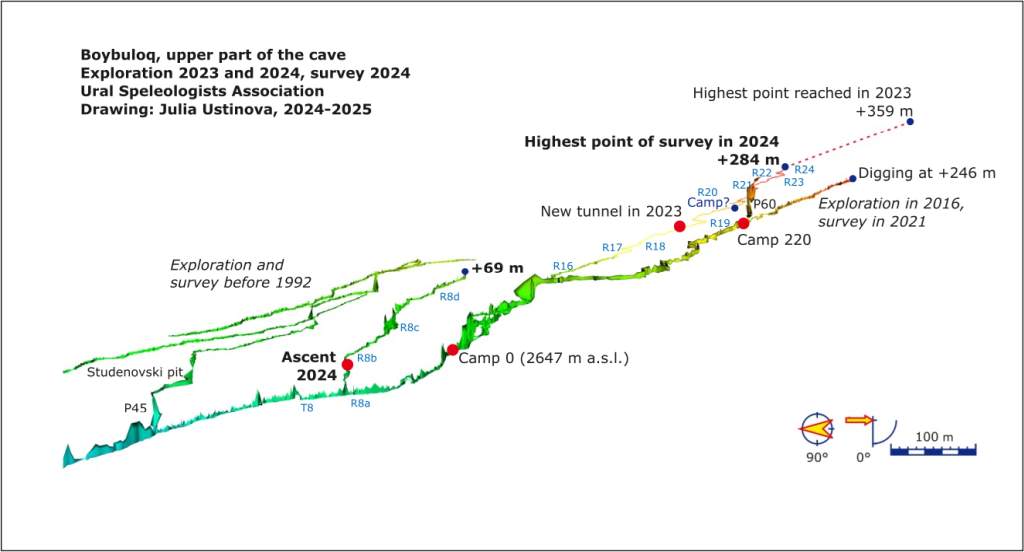
Figure 2: Map of the part of Boybuloq, around Camp Zero (0), explored in 2023 and 2024, with survey made in 2024.
August 4: Saša and Zdeněk were at 13.40 at the beginning of the new part, discovered in 2023. Survey from "solniško" (cute word for the sun) to Camp ? (the only place for a camp in that tunnel, but "questionable" - just a small widening in the passage, in fact very poorly suited for a camp). They started surveying at 14.15, finished at 20.00. Polygon length was 500.6 meters, the altitude gain 92.5 meters. They returned at 21.15 to Camp Zero. In the passage closer to Camp ? it was cold, windy.
R17 - on the right wall at the top there was a small passage - an old tributary, runs above the main passage;
R18 - on the right wall there was also a passage, about 0.6 m high;
R19 - water inflow on the left wall, wide at the beginning, then narrowed and at the end a hole about 0.2 m in diameter, from where the water flowed;
R20 - a small grotto 1.5 x 1.5 m with a beautiful stalagmite in the form of a small throne, Camp ?. The inscription read "08/15/2023 Snežinsk, Perm". Kolja was overtired, felt unwell, will go to the surface with Maša. They departed at about 14.30, reached the base camp at about 20.00.
August 5: Contact with the surface was established (over Nicola phones). Ljoša and Jarek will arrive at Camp Zero by 19.00. Saša and Zdeněk made a photo shooting, rigged additional traverses to bypass the water pools, widened the passage from benchmark 8 to Camp Zero. It would be necessary to recalibrate the Leica Disto (it showed a strong error, referring to magnetic deviation) and to check the operation of the topodroid. Saša and Zdeněk widened a narrow spot near the benchmark 8. Saša met Ljoša and Jarek under "K40" at 19.56. They reached Camp Zero at 21.20.
August 6: Saša and Zdeněk departed in the morning. They left the camp at 10.15, arrived to the surface at 12.32. Jarek and Ljoša went to explore the new passage until the lower meander crossed it. Ljoša and Jarek went along the meander from the benchmark 16 along the passage with white clay - the passage was narrow, they crawled for about 1 hour on their knees, after that the passage became too narrow.
August 7: Ljoša and Jarek checked the chimneys above Camp Zero. The theory was confirmed - everything was leading back to the Camp Zero grotto. They ascended into the chimney between benchmarks 8 and 9, climbed 20 meters. Found a passage with water and draft which joined the chimney, the passage continued upwards, after 30 meters there was another chimney 25-30 meters high. They climbed it halfway, to a shelf.
August 8: Ljoša and Jarek continued climbing, above the chimney the water was flowing from a fissure, and the main passage turned to the left. A narrow meander with steps of 2-3 meters followed, already without water, they rigged one step, then the meander continued with another, 8-meter chimney. On top of it, a meander forked off to the right, possibly with water, which appeared below. There was a flat area and water, but no rocks from which a platform for a camp could be made. After the ledge there was another chimney of 15 meters, they climbed 12 meters along the rocks and rigged it. Saša and Zdeněk entered the cave at 16.40, took some photos and videos along the way, and arrived to Camp Zero at 19.30.
August 9: Saša and Zdeněk continued the survey in the new part from Camp ? towards the crossing lower meander and further. Ljoša and Jarek continued climbing into a series of chimneys and made a stationary rig. Saša and Zdeněk left at 10.30, arrived at Camp ? at 12.26. They started the survey at 12.40, finished at 18.40 and headed back. They returned to the Camp Zero at 21.10. They made a survey from Camp ? to R24 (fork at the top of the meander - straight over the water, right passage with draft), about 20 m. They also surveyed the lower meander until the ceiling lowered, a puddle followed and the ceiling got higher again, but a wetsuit would be required. There was draft along the entire meander and it was very cold. The survey length was 432 m, the difference in height was 90 m. Ljoša and Jarek de-rigged the end of the Camp Zero grotto. They continued climbing in the last chimney, made a stationary rigging. After the last chimney, three steps of 2, 4 m, and 3 m followed. The continuation were two meanders, the left one was very narrow, but one could still crawl, the right one had water and draft. They proceeded from the fork for 20 minutes, along the right meander. At the end there was a chimney about 7 meters high. They returned to Camp Zero at 21.00.
August 10: Ljoša and Jarek left Camp Zero for the surface at 14.10. Saša and Zdeněk made a topographic survey from the benchmark 8 along the new ascent. 173 m were surveyed and the altitude difference was 55 m, including from the benchmark 8 to the start of the ascent, where they installed the benchmark R8A. Two chimneys were surveyed from there on, and a fork was reached after the second one, where they installed the R8B benchmark, on the left side. There were two routes from R8B - the left one was dry, the right one had a stream.
August 11: A radio connection with the surface was planned but it failed. The cave team overslept the agreed time as the alarm clock didn't go off. Maša and Dima will come after lunch. Saša and Zdeněk widened the approaches to Camp Zero in three places - now crawling is no longer required, one can either stand or bend over. After returning, they completed the platform under the tent by expanding it on the right side. At 20.20 Dima and Maša arrived, from the cave entrance it took them 4 hours 30 minutes.
August 12: 10.00 Saša and Zdeněk left for the surface. 13.00 Maša and Dima left to survey the new passage from R8B on. At 19.00 they finished surveying, they reached a dead-end. It will be necessary to make 2 more anchors for the benchmarks R8C and R8D. There was a choice either to survey the tunnel with water or go up to R8D along the meander. Maša and Dima returned to Camp Zero at 20.50.
August 13: Maša and Dima contacted the surface - Ljoša and Doktor will arrive in the evening, after the dinner. At 12.50 Dima and Maša went to survey the continuation of the passage upwards of the R8D. On the way they installed the anchors with labels R8C and R8D. They ascended 4 meters, rigged the passage, made a survey 20 m high and 90 m long into the chimney. Climbing was required. They set the R8E benchmark, the anchor will have to be installed there, and returned to Camp Zero at 19.45. Doktor and Ljoša entered the cave at 13.30 and arrived to Camp Zero at 18.00.
August 14: Maša and Dima left the Camp Zero for the surface. Ljoša and Doktor continued exploration of the passage above the meander between the benchmarks 8 and 9.

Figure 3: View up the last chimney to which Ljoša and Doktor climbed, above the top of the meander between benchmarks 8 and 9, on August 15. The flooding waters drained down this chimney. It is quite wide and continues at least 15 meters upwards. Photo by Aleksej Serëgin.
August 15: Doktor and Ljoša packed Camp Zero. They made a survey of the passage from the benchmark 8A to Camp Zero and reached the surface at 17.30.
4. Caves on top of Chul-Bair
On August 2 Daša and Dima departed towards the top of the Chul-Bair ridge, about 2 km further to the northeast from the entrance of Višnevskij cave, to search for possible new cave entrances. They established a camp at 3800 meters above sea level. In the following days they descended from the ridge along the ledges in the wall, up to 120 meters deep, and 600 meters from the camp in both directions, northeast and southwest. They discovered 6 new caves, 4 of them were closed by ice immediately after the entrance, 2 were more promising, both at the elevation of 3768 meters, 50 meters apart.
 |
 |
 |
Figures 4, 5 and 6: Medvežja peščera (Bear cave) - location, entrance and bear skull, by Daša Krasnojarova, August 2024
On August 11 Kolja replaced Dima in the top of the Chul-Bair ridge cave prospecting duo. After a day of digging into frozen snow (about 1 m3 of it was removed) Kolja and Daša opened a tunnel in the ice. They managed to proceed 20 meters where the ice cork prevented further advance. The second of the two caves was horizontal and it turned out to be an old bear's den. Kolja and Daša discovered many bear bones and 4 skulls. A strong stench was noticeable in the cave, it smelled of bear droppings. After 70 meters the tunnel was no longer passable as the ceiling lowered too close to the frozen lake surface. After the bears the cave was named Medvežja peščera (Bear cave). Its entrance is located 1900 meters to the northeast of the entrance of Višnevskij cave and 246 meters higher. Should the global warming melt the frozen lake in the Bear cave and if the connection of the tunnels that drain the water through the Chul-Bair mountain from the Bear cave, Višnevskij cave and Boybuloq be passable to man, the resulting cave would be 2033 plus 246 = 2279 meters deep. Terminal siphon in Boybuloq is located at an elevation of 1489 meters above sea level, the entrance at 2647 m, its highest point at 3006 m, terminal siphon in Višnevskij cave at 2239 m, its entrance at 3522 m, and the entrance of Bear cave at 3768 meters above the sea level. On August 16 Darja and Kolja returned to the base camp.

Figure 7: Group photo of the Chul-Bair 2024 expedition, August 1, 2024, by Jerzy Zygmunt. From left to right: Jurek, Ali, Dima, Daša, Kolja, Maša, Jarek, Kazik, Ljoša, Saša, Doktor, Halid and Zdeněk. Ali and Halid are expedition escorts from Dehibolo, sons of Sadyk.
5. Jarek's view
The following flow of events is a chronologically ordered recount by Jarosłav Rogalski - Jarek, slightly adapted by the author.
On August 1 Kolja, Jurek, Kazik and Jarek transported the equipment for Darja and Dima to the Chul-Bair ridge. On the way they visited a large grotto in the canyon wall. Kolja showed the dinosaur tracks. The party hid the cargo behind the top of the ridge at the elevation of Višnevskij cave (3522 m a. s. l.) and returned to the base camp.
On August 2 Ljoša, Jurek, Kazik and Jarek transported the equipment from the Boybuloq entrance to the place behind the Mustafo's pit. They entered the cave immediately after the bivouac team: Maša, Kolja, Saša and Zdeněk.
.jpg)
Figure 8: Grotto in the canyon with dinosaur footprints, August 2023, by Ljudmila Bašarina. It is one of several such, very rarely visited, great tourist attractions of this part of Uzbekistan. The dark frame amplifies the enchanting view of the rugged canyon wall on the other side and mighty Hodja-Gur-Gur-Ata ridge with the iconic Katataš tower on the far horizon.
Doktor, Jurek, Kazik and Jarek transported the equipment to the ridge for Daša and Dima. They helped to move the camp. The shepherds showed them the source of water - a spot with easily accessible snow on the ridge. It was essential for the success of the ridge camp, carrying the water from Boybuloq was not a viable option.
Doktor, Kazik and Jarek drained the mud from the Boybuloq entrance areas. Jarek collected the clean water while Doktor and Kazik removed the mud.
Ljoša and Jarek went to the main bivouac in Boybuloq, to Camp Zero. They stayed 4 days and 5 nights. They continued the exploration of the new cave part, discovered in 2023 above Camp Zero. After that they climbed one of the chimneys above the water supply below the bivouac. They discovered a series of meanders and rock steps above it (one of the chimneys continued into a larger hall). They however could not finish the climbing during Jarek's stay in the cave. They stopped at a small chimney (7 meters) - they were too tired to climb it and had to return to Camp Zero. Unfortunately, Jarek could not return to the cave for the second time with Ljoša as planned. His "oil skin" caving suit was no match for the sharp rocks of Boybuloq. It fell apart. Jarek and Ljoša's stay at Camp Zero overlapped with the stay of Saša and Zdeněk. The space is limited and it was quite crowded in a small tent. Saša and Zdeněk worked in the highest part of the cave, discovered in 2023 above Camp Zero (which increased the cave depth from 1430 to 1517 meters). They tried to get as far and as high as possible, making a survey at the same time.

Figure 9: Polish team above the Mustafo's pit, 2 August 2024, by Aleksej Serëgin. From left to right: Jurek, Kazik, Jarek.
During this time Jurek and Kazik checked the mountain slope above the cave for possible cave entrances (as instructed by Saša), got to know the Chul-Bair area, arranged transport to the ridge for Daša's team, worked in the base camp.
After Jarek's return from the cave and a day of resting Jurek, Kazik and Jarek went to the ridge and set up a bivouac above the wall, not far from Daša's and Kolja's bivouac. They operated on the ridge for 4 days. Day one - Jurek and Kazik stayed on the mountain. Daša, Kolja and Jarek descended from the top of the wall to the "ice-covered hole". Jarek was digging in the ice - more precisely - chopped the ice in the hole. Daša and Kolja searched the wall and discovered a cave with bear skulls (reminds one of the cartoon Maša and the Bear). Daša, Kolja and Jarek explored this cave. Day two - Daša, Kolja, Jurek and Kazik explored the Bear cave and prolonged it a bit - by a chimney over an ice lake. Later Kazik and Jarek were digging into the ice in the "ice-covered hole". Unsuccessfully. Day three - reconnaissance. Jurek, Kazik and Jarek hiked along the ridge to the northeast. On the way back they found holes filled with snow. Only one (found by Jurek) was open, without snow. It is located more or less in the line of descent of the lower peak of Chul-Bair, at an altitude of approx. 3600 m a. s. l. Tonnelnaja cave was marked on the map in this area. Jarek did not know its description, so he could not know if it was Tonnelnaja or not. Day four - Daša, Kolja, Jurek, Kazik and Jarek carefully reviewed the objects found the previous day. Kolja descended into the abovementioned pit mentioned above. The pit is approx. 7 m deep and filled with stones at the bottom. But it is warm, it is completely free of snow.
This ended the exploration on the ridge and caving activity of Jurek, Kazik and Jarek. They collected the equipment and descended to the base camp.
After the expedition, on October 27, Jerzy Zygmunt - Jurek, the underground successor of the great storyteller Henryk Sienkiewicz won the audience award for his presentation, titled Chul-Bair 2024, at the Speleoconfrontations 2024 event, organized by Speleoclub Dąbrowa Górnicza.
6. Visitors
Though Boybuloq is currently ranked 12th among the deepest caves in the world, not quite near the top, it is already a major magnet in the caving world. Its location, in an exotic ancient land of special attraction, on the Silk road and not far from the Himalayas, cave's tragic discovery in 1970, the fast approach of its sibling in the high mountains, the Višnevskij cave, from 2.95 kilometers to the NE and 875 meters higher at its discovery in 2015 to just 50 meters away at the same elevation in 2021, with a promise of a supercave, have all put Boybuloq to the top of many cavers' wish list. But Boybuloq is not an easy, off the shelf tourist destination, the cave is not yet in the program of travel agencies, the starting point, Dehibolo has no guesthouse and is 3 hours drive on an all-terrain vehicle from the nearest town, there is the language barrier - in Uzbekistan, with the exception of major tourist destinations such as Samarkand English is not enough, knowledge of Russian is essential - and there is the situation after the February 2022. All these factors diminish the potential multitude of visitors to just a few, if any.
Not so in 2024. As already mentioned in the previous chapter, the Boybuloq 2024 expedition took place from July 30 to August 20. From August 15 to August 17, 9 people visited the base camp of the expedition above the entrance of Boybuloq. Their portraits, taken mostly in or at the Boybuloq cave, are shown below. They came from the following places: Vedran Ferenčak, Čedo Josipović, Luka Ivančić, Marko Ličko and Gorana Perić - Goga from Zagreb, Paul Karoshi from Graz, Holidin Poënov and his daughter Farangiz Kudratulaeva from Dehibolo, and the writer of these lines, Primož Jakopin - Klok from Kamnik pod Krimom.
 Vedran |
 Čedo, base camp |
 Luka |
 Marko, Karaha saddle |
 Gorana, Karaha saddle |
 Paul |
 Holidin |
 Farangiz |
 Klok, Osp cave |
How did they come? The Croatian group (Paul has a bond with Gorana) decided to have a look at the cave during their trip to Uzbekistan, which included Buhara, Samarkand, Tashkent and the Ugam Chatkal National Park (visited using rent-a-car). For the author it was the third trip to Chul-Bair, he stayed in Dehibolo at the house of Holidin, whose daughter is Farangiz. Vedran phoned the author to get the general impression of how to get to Boybuloq and through Vadim Loginov and Aleksandr Kuznecov of ASU agreed the stay of the group in the expedition camp on Chul-Bair, as did the author. The group of 7, which benefited from the visa-free entry to Uzbekistan for most European countries (up to one month), arrived by plane from Istanbul to Samarkand in the morning of August 14, Marko two hours later than the others. The travel continued by two taxis from Samarkand to Boysun. It was a fairly non-eventful 5 hour trip, including lunch mid-way and a rather nasty surprise towards its end - never pay the middleman for the ride when hiring a taxi, especially not in advance. Shopping for provisions (Holidin helped) in the open market of Boysun was as usual, the only difficulty was finding rubber boots for Holidin and the author, both EU size 42. Checked baggage weight limit on Turkish Airlines flights is 30 kilos, a generous figure, but if you also bring a tent, sleeping bags and pads, caving gear (without climbing accessories) for three persons, gas cooker, a few pots and the like, it is not enough. Rubber boots simply did not fit in. Holidin in the end managed to find two pairs in two different stores, the only two in the market (and most likely elsewhere in Boysun), black, size 44. So, despite thick woolen extra socks, walking in the cave would just have to be extra comfortable. 3 hour drive in two Soviet-era jeep taxis from Boysun to Dehibolo followed, of which 2 hours was over rough mountain tracks. The six spent the night at Sadyk, while the author stayed at the house of Holidin and Dilafruz.
On August 15 in the morning (not very early) we all departed on foot to the expedition camp (a 1000 meter ascent). The Vedran group, carrying the luggage themselves, departed between 8 and 9 in the morning, using the gentler but longer western route, the remaining party of three left about two hours later. In Dehibolo more or less everybody knows where the entrance to Boybuloq is, and would like to visit the cave for which the village is famous, but the 7-meter low and narrow entry passage that requires crawling in the mud and water makes such an endeavour out of reach for ordinary people. Holidin and Farangiz were both eager to see Boybuloq from the inside, what was also a longtime author's wish, and now it was a good opportunity - and, as the saying goes: It's now or never. We took a considerably shorter but steeper direct route to the Chul-Bair ridge, over the Karaha saddle. The luggage was carried by 2 donkeys. In the expedition base camp we were all greeted by Saša, Maša and Dima, and we pitched tents next to the others.

Figure 10: In the wider part of the Boybuloq meander: Saša, Doktor, Ljoša and Maša, August 16, 2024.
The next day, August 16, two parties visited the cave. The first were Vedran, Luka and Paul, all seasoned cavers from the depths of Velebit caves, accompanied by Zdeněk, who participated in several exploration trips to the cave. Marko could not go because during the travel from Istanbul to Samarkand his checked baggage, including the caving gear, was misplaced and arrived a day later; he recovered it on return, some 14 days later. They entered Boybuloq at 10.30, and arrived to Camp Zero at two o'clock in the afternoon. They collected the equipment of Ljoša and Doktor and brought it to the surface. The second group: Holidin, Farangiz and the author, accompanied by Saša and Maša, entered the cave at 3 o'clock in the afternoon. The idea was to proceed along the meander 600 meters slightly upwards till the Mustafo's pit, which is quite wide and 27 meters deep. It is a distance which experienced cavers usually cover in about an hour, and we planned to take pictures on return. But the author, born at the end of the first half of the past century, was not fast and skilled enough, especially at overcoming the narrow sections of the meander - sidewise crawling at mid-height, not at the bottom, was the biggest problem. At 150 meters from the entrance he calculated that he might succeed in getting to the Mustafo's pit and back until the evening, but no energy and time would be left for the photo session. As Saša and Maša also told him that the narrow meander continues all the way to the Mustafo's pit, without any halls or wider parts, the decision to turn around and take pictures on the way to the cave entrance was not difficult. Holidin and Farangiz performed surprisingly well, no obstacle would stop them. The photos of this visit are shown in the second article of the photo report in the chapter 8.
7. Returning home
On August 17 all the visitors returned from the expedition's base camp to Dehibolo, together, taking the short route. On August 18 Vedran's group, which stayed at Sadyk, departed to Boysun in two jeeps, and took the evening train from Boysun to Samarkand. According to Vedran it was the most comfortable ride of the entire voyage. The expedition returned from the mountain to Dehibolo on August 18 in the early afternoon and after a good meal and some rest at Sadyk's house the author, who was staying at Holidin, conducted a short interview with Saša, Ljoša and Daša about the course and achievements of the expedition. On August 19 at six o'clock in the morning (an hour later than foreseen) the expedition, together with the author, departed to Boysun aboard an all-terrain truck. After a minor glitch, connected to a traffic violation at the arrival in Boysun which took and hour and a half to resolve, after a meal and a shower in the Hotel Boysun, the party departed to Samarkand in the early afternoon by rented minibus. In the evening all expedition participants and visitors, except Holidin and Farangiz who stayed in Dehibolo, and the author, who had a plane to catch very early on August 20, gathered at the farewell dinner.
On August 20 the Russian part of the expedition left to Tashkent by train and from there home by plane. The Polish part spent the day in Samarkand. In the morning a hairdresser, a bit of wandering around the city and a late evening flight to Istanbul, from there to Krakow. On August 22 they were home. The Vedran's party also stayed in Samarkand for another day. They wanted to go to the Zaamin National Park 50 km to the east of Samarkand, known as "the Switzerland of Uzbekistan", but after they learned at the park's info center that access was severely restricted due to the risk of forest fires the visit was canceled. On August 21 they departed to Bukhara, from there to Tashkent and later, using rent-a-car, to the Ugam-Chatkal National Park where they spent nearly a week and which impressed them greatly. From there they returned to Tashkent, to Samarkand and home.
8. Photo report
The author's voyage to Chul-Bair and his return are documented in the following articles, 148 photos in all, accompanied by short descriptions. Some of them, mainly portraits, were already shown in this report.
9. Conclusion
There were 4 achievements of the Boybuloq 2024 expedition: the continuity of the cave exploration was preserved, the survey of parts, discovered mainly in 2023, increased the cave length by 1,5 km to 19,9 km, a new continuation with strong draft, leading in the direction of the Chul-Bair ridge wall was discovered and, last but not least, a new promising cave was discovered near the top of the ridge, 246 meters above the entrance to Višnevskij cave, at 3768 meters above sea level.
And what can be expected on Chul-Bair in 2025, in the all-important year, very likely the third consecutive hottest year in modern time, predicted by many to be a turning point in history, when the rule (dictatorship is not a nice word) of the superclass became the name of the game in the world's foremost superpower, the year when the reshaping of the Old World, looks almost certain, when thinking of bright future has become a challenge?
As befits a year like this, a lot is on the agenda. The 2025 ASU (Assoсiation of Ural speleologists) expedition is planned for the standard and most favorable time of the year, for August 2 to 23, under the leadership of Vadim Loginov, a large expedition of 35 people (as of March 2025). The main areas of work in Boybuloq and its surroundings will be:
- in Boybuloq, search for a connection with Višnevskij cave and search for a bypass of the siphon in the area of the Camp -560
- in Boybuloq, exploration and survey of tunnels in the area of Camp Zero (discovered in 2023 and 2024) which lead in the direction of the Chul-Bair ridge wall; foremost will be the section between points +284 m and +359 m on Fig. 2
- search for cave entries in the wall of the Chul-Bair ridge, in the area to which the abovementioned tunnels lead
- at the bottom of the Višnevskij cave — searching for a connection with Boybuloq.

Figure 11: Northern group of the Hodja-Gur-Gur-Ata caves, 2021. Isetskaja of the Southern group gets to within 800 meters from Dark Star.
A group of cavers, led by Evgenij Curihin, will head to the caves in the Hodja-Gur-Gur-Ata mountain ridge. The access route to their base camp from the village Kurgancha (1450 m a. s. l.), the last before Dehibolo, takes two days, as the transfer of equipment by donkeys is only possible till the elevation of 2400 meters (day 1), further trail to the saddle in the ridge is too steep and to the base camp at 3250 meters cavers must carry the equipment and provisions themselves (day 2). The last expedition to the vast and colorful cave network with much wider tunnels than Boybuloq took place in 2016. The objectives for 2025 are the following:

- revision of the old part and exploration of a new passage, discovered but unchecked in 2016, in the cave Isetskaja
- revision of the upper old part of the cave Dark Star
- inspection of the ridge wall from Dark Star to the (northernmost) Ulukbek cave for possible new cave entrances
The moment, when the Arabika massif, at the northwestern corner of the Caucasus mountain range which connects Europe and Asia, will be joined by Chul-Bair ridge at the west-southwestern tip of the Tian Shan family of mountain ranges in Central Asia as the second supercave hot spot, has not quite arrived yet. But the bloom of Uzbekistan's dark underground rose is getting closer, year by year, slowly but incessantly.
Related posts:
- This page in Russian ...
- ... and in Slovenian language
- Expeditions Chul-Bair 2022 and 2023
- Expedition Chul-Bair 2021
* Photos in the report were taken by the author, except where stated otherwise in the photo descriptions - in such case the photo was published with permission of its author.
For greater accuracy the cyrillic names in this report were romanized according to the
Scientific transliteration
of Cyrillic with the pronunciation of the main additional characters as: č = ch, š = sh, ž = zh,
y = hard i, j = y, ë = yo, u = oo - i. e. Dmitrij Čeredničenko = Dmitriy Cherednichenko.
 The cave Velika Karlovica, August 8
 Uzbekistan 2024: From Brnik airport to Boybuloq cave, August 13 - 15

This page, text and photos copyright (c)
Primož Jakopin, member of the Ljubljana
Cave Exploration Society (DZRJL), except when noted otherwise. The photos were taken in August 2024,
with the exception of the Fig. 8 (August 2023), text was improved by Vadim Loginov in many places.
Send inquiries and comments to primoz jakopin guest arnes si (insert dots and at sign as
appropriate). The page was written mostly in September and December 2024, January 2025; date of the last
change: April 26, 2025.
URL: https://www.jakopin.net/primoz/slike/Boybuloq-2024_en.php
624