Primož Jakopin, photo diary
Planinsko polje sinkholes, Križna jama and Mitjina jama
Water and Caves
January 29 to February 8, 2026, 67 pictures
Most images are approximately 768 x 1024 pixels in size.
Numbers in front of picture descriptions are serial numbers of the original photo files.
During the excursion to Križna jama, the author was assisted by Alojz Troha.
In Mitjina jama (pron. Meetyinah yamah) Vladimir Levašov, Mihail Tertični, Sandi Rutar and Jana Paderčič
made the author's work much easier and more enjoyable. Again, most of the photos, but not all of them, were
taken handheld, without a tripod. The names of the caves (synonyms are also used) and parts of the caves
are often the author's.
The purpose of the excursions was primarily to take photographs, find new motifs, and
overcoming the problems that arise in doing so.
Page, text and photos copyright (c) Primož Jakopin - Klok 2026, except for the photos
VL91, VL92, VL93, VL94 and VL95, which were made by Vladimir Levašov and are published with his
permission.
Southeastern edge of Ljubljana Marshes, January 29

56695. View towards the WNW across the marsh and the lake formed by the high Ljubljanica, with rising fog and low clouds

56696. The fog had already lifted a little and Grmada, 898 metres, appeared, followed by the highest mountain on the horizon, Tošč, 1021 metres above sea level.
Škofji lom on Planinsko polje, February 1

56697. The receding river Unica flowed up to the sinkhole in front of the Trajberca field cart track, from which the picture was taken. In the background is Planinska gora.

56698. The lower entrance to the Cave in Škofje lom was still buried under the driftwood left by the high water of the last flood.

56699. Upstream view along the dry riverbed of Unica, just before the sinkhole Maocetungova jama

56701. View from the bottom of the cave entrance to the metal rakes that prevent larger logs from blocking the passages to the cave interior.

56700. A large stone that broke off from the supporting dry stone wall above the entrance knocked off the already slightly weathered slab of rock at its base and this colorful pentagonal fragment was created.

56705. The drained water of Unica left behind a deposit of friable earth, which was soon partly washed away by rainwater from the ceiling.

56703. View of the small dune in front of the siphon ...

56704. ... and to the fissure above it.
Pod stenami (Under the Walls)

56706. The metal fence of the walled eastern sinkhole, Veliki Katavotron, was just below the water level of the slowly receding Unica, ...

56707. ... while the fence of the western, Mali Katavotron, was a little deeper below the surface and could barely be noticed due to the reflections in the water. The view is from the path at the northern edge of the riverbed.

56717. Much later, at dusk, a view of Mali Katavotron from the south side, without reflections.

56708. Three bluebells, Galanthus nivalis

56711. View from Fortunatova jama across Unica and further along the meadow towards the forest

56714. View from the entrance to the cave interior, to the step leading to the active, lower floor of the cave - left in the middle of the image, behind the author's feet.

56713. Surprisingly, the passage to the lower floor was not blocked with debris, but left open. Yet the author was not too tempted by the muddy and wet access and decided to skip the passage into the depths.

56715. At one of the westernmost sinkholes of Pod stenami area, the water sank into the driftwood well before the cave.

56716. Branched flows to the sinkholes on the western edge of the Pod stenami area

56718. Along the southern bank of the western branch of the Unica, it was possible to reach the river's fork. In the picture - a view across Unica to the south, with the western edge of Jakovški hrib, Javorniki and Planinska Gora.
Križna jama, February 5

56724. Two small stalagmites in front of the wall, covered with dripstone balls.

56725. The same scene from a lower standpoint and with a visible path of a drop from the ceiling

56726. View of the end of the tunnel that leads above the pier in the First Lake to the riverbed in Connection Tunnel

56727. Face-like arrangement of a water jet from a chimney on the surface of the First Lake

56729. Two small stalagmites with micro-rimstone pools on the path above the First Lake

56730. Traces of a larger jet from a chimney above the same path, lit from the side

56722. Cave pearls

56732. Rapids on the bend before the Ponor...

56733. ... and in front of the entrance to it.
Mitjina jama, February 8

56734. Towards ten o'clock in the morning, the fog had already cleared up somewhat - a view of the sun through the fog in front of the village of Tublje.

56736. Vivid ceiling decor above a shelf in the Entrance Hall. From these shapes alone, it was possible to conclude that today's visitors are in for some other pleasant surprise.

56735. View along the tunnel that continues northward from the entrance, in the direction of the cave Jezerina

56738. A slender stalactite column in the tunnel that leads from the Entrance Hall towards the Paradajs Hall, with Miha.

VL91. The column is remarkable and Sandi also decided to take a picture of it. Miha had already moved ahead, there was no other extra at hand, so the author volunteered — he has a slightly unusual stomach shape, because there are two small floodlights and a few other items in the caving suit above the waist. A little further ahead was Vladimir, who also didn't want to waste the time and decided to take this selfie with a story in the background.

56739. Sandi is returning from the passage that leads from the White Hall to the tunnel Ne grem na kolena (I'm not going down on my knees), Jana is illuminating him.

56740. Micro-rimstone pools with two small stalagmites and various stalactites at the side wall

56741. Rock ribs along the side wall

56743. Dripstone lodge with a dark curtain above the fortunately not too deep water on the bottom of the tunnel

56744. A slightly thickened straw column, like a pencil, just much longer
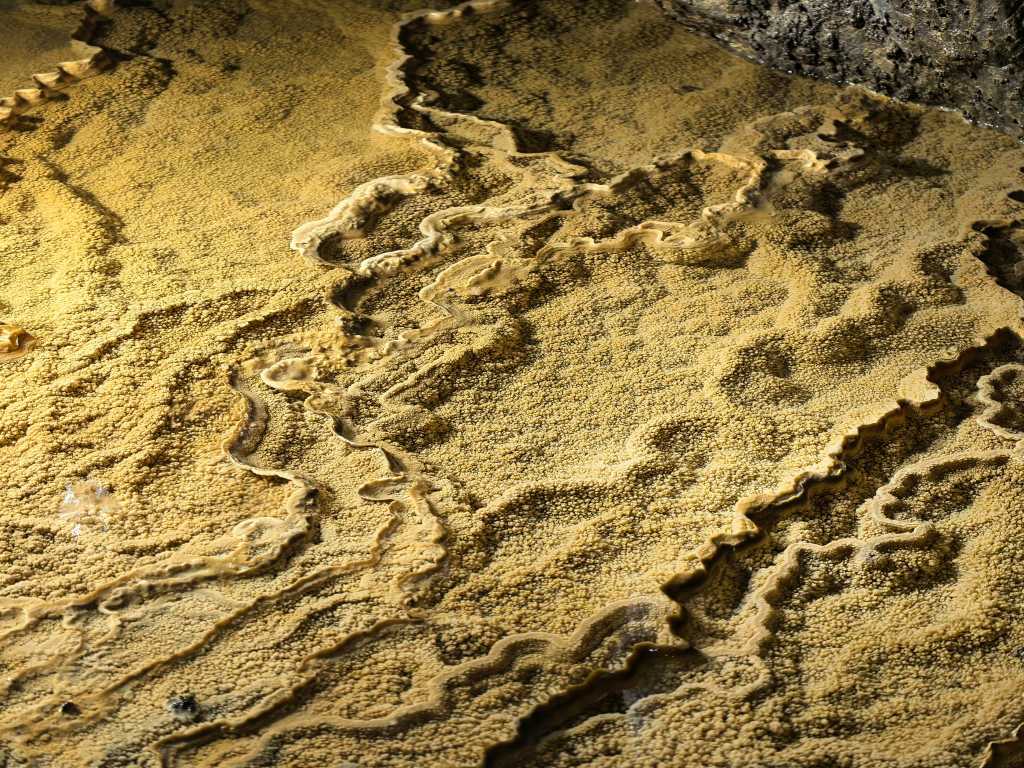
56746. Shallow rimstone pools in the shades of sandy color, with a crystal sprinkling on the bottom and with luxuriously curled edges

56750. A three-horned stalactite with a straw on the side, lit from behind by Sandi, and from the front, just a little bit, by the author.

56754. A figure composed of dripstone oval shapes from light gold to olive gold, reminiscent of a statue of a reclining Buddha

56755. A series of stalagmites ending with two double headed ones and ...

56756. ... an inclined three-horned one.

56759. Not far away, this, slightly different three-horned stalagmite formed, its highest horn changed the growth direction not once but twice.

VL93. The making of the previous photo, Sandi and the author

56760. Rhapsody in yellow-green - a rock balcony in a dripstone wall with a rimstone pool illuminated from the water

56763. This luxurious scene opens up under the top of the hall. A timeless play of shapes in stone, so different from the Nick Cave's contemporary hustle and bustle, an exhibition which also opened on Friday, February 13, 2026. We were all delighted, how could we not be!
Unfortunately, in addition to classic beauty (the link brings a short but excellent article by Ksenija Miličević), cave beauty has also been under attack recently. Anyone who describes the translucent whiteness of overflowing, exhilarating cave formations in a derogatory, not to say humiliating, way as stalactite kitsch or cave kitsch clearly does not know very well what the word kitsch means. Kitsch is a term applied in art and design that is perceived as naïve imitation, overly eccentric, gratuitous or of banal taste — in short a piece of no artistic merit. Its synonym is junk. For every true caver, stalactites, no matter who made them, have artistic value. Great, priceless. And the opinion that in caving, only overcoming the most difficult problems on the verge of survival, in high mountain karst, enddless sequences of sharp-edged meanders and shafts sprayed with ice-cold water is worth something, and everything else is considered inappropriate and should be despised, unnecessarily takes away the will and joy of all other explorers and lovers of the karst underground. Of those who do not belong to crème de la crème. The fact that Gorjanc, the most beautiful cave discovery in Dolenjska region of Slovenia (Lower Carniola), after 4 years of digging through countless narrows, had to learn six times (so it is hardly a joke) in the first major pictorial report that it was kitschy, really does not help anybody.

56764. The curly end of the left edge of the dripstone heap from the previous photo ...

56766. ... and the slanted column in the middle of the right side, only here ...

56767. ... in a view into the hall and not out of it.

56768. The dripstone heap from the photo 56763 is complemented by a ceiling with cave straws. Miha was even more impressed than one might deduct from the photo.

56769. There are many rimstone pools in the cave. They were sometimes dry, as in this photo, ...

56770. ... and more often filled with water, ...

VL94. ... here they are depicted in a slightly wider view, one could say: placed in space.

56773. In the middle of the upper part of the Paradise Hall, a pile of flat rocks, fallen from the ceiling, were later covered with dripstone, and several arched little chambers were created, and in front of them (bottom right) ...

56772. ... this unusual sculpture formed, most reminiscent of the chanterelle mushroom, Cantharellus cibarius.

56774. Immediately below it is a shallow lake, and in it is a volcano-shaped dripstone cone, just under a meter high.

VL92. Speaking of unusual stalactite shapes - Vladimir found this strange stalactite when he and Miha delved deeper into the more hidden tunnels of the cave while the author, Sandi and Jana took their time in the Paradise Hall for some more elaborate photos and did not need the help of their more exploration oriented and, to be honest, much younger buddies. It looks as if the small stalactite ran out of steam to continue growing and decided to lengthen into a straw. However, the inflow of limestone-saturated water increased greatly and a stalactite shape resembling a long soup dumpling was created.

VL95. Stalagmite forest, from the same part of the cave

56775. The hall floor ascends behind the "mushroom", the passage is dripstone covered, and there are two large curtains on the side.

56776. On the other side, towards the bottom of the hall, there is first a small lake with emerging stalagmites, ...

56777. ... and, after a considerable descent, the water is dripping from the ceiling into a large, but very shallow lake from a great height. It has created an almost perfect pattern of concentric circles on the surface.

56780. Excursionists under the high arch towards the end of this long and high hall (Paradise)

56783. In the left part of the previous photo, there are several beautiful dripstone heaps above the lake. Sandi (center right) helped with the lighting.

56786. Another very thin stalactite column, the height from stalagmite to the top is approximately 25 cm.

56787. Miha, the initiator of the excursion, just below the top of the entrance fissure of the cave, view from the surface
Related pages:
 Mala Karlovica, Skednena and Najdena jama, January 3 to 18, 2026
 From Rakitna to Ljubljana and the Sea, April 4 to 11, 2026

This page, text and photos by Primož Jakopin,
member of the Ljubljana Cave Exploration Society (DZRJL).
Send inquiries and comments to primoz jakopin guest arnes si
(insert dots and at sign as appropriate).
Page was published on February 13, 2026; date of the last change: April 14, 2026.
URL: https://www.jakopin.net/primoz/slike/2026/PJ20260129_en.php
349