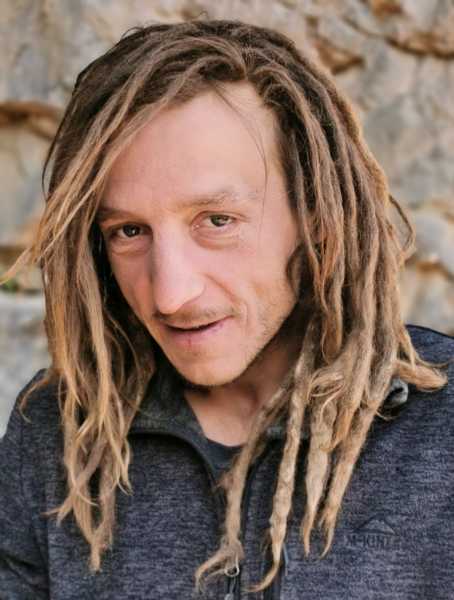
On the Chul-Bair mountain, 2021
On the Chul-Bair mountain, 2021
Who is Mitja Mršek?
I was born on May 22, 1980, in Kranj, to father Božidar,
a surveying engineer, and mother Irena, née Puc, a workflow coordinator
at the Cerknica Municipal Tax Office. I have two brothers; Matjaž is a little
younger, Samo is ten years younger, and all three of us have passed the caving exam.
Matjaž and I were the first brothers to reach -1,000 meters in the Čehi 2 cave in 2002.
My cousin Janez Puc had already been to -1,500 meters — in Čehi 2, we
were the first to reach the bottom together with Janko Marinšek, Matjaž Milharčič,
Tomaž Česnik, and Aleš Štrukelj. Ana Makovec reached
the camp at -1,370 meters at that time.
I consider the Rombon Cave System to be my greatest achievement.
What were your early years like?
From age six to thirty, I played soccer, training
three times a week, for FC (Football Club, soccer sounds somewhat pejorative) Rakek and also for
FC Cerknica. In sixth grade of elementary school, I was the municipal champion in the 1000-meter run.
In the first grade I was knocked unconscious by a hearse at a crosswalk, and
if I mess up or do something wrong now, I can use that as an excuse.
When I was still little, around five years old, my great-grandmother on my father’s
side — she was born in 1902 and died in 1987 — we still had
a black-and-white TV, and a mountaineering film was on. A climber
was climbing in a chimney with his legs spread apart, and my great-grandmother started yelling:
“Where are you crawling, where are you crawling, let someone turn off the TV!” That scene
really shook me, and something inside me clicked.
Did that event lead you to caving?
The first time we went into a cave was in 1990 or 1991 — just the three of us,
on our own, in the winter under the Small Natural Bridge (in Rakov Škocjan, author’s note);
the others were my brother Matjaž and Damjan Intihar-Brńte. The snow was melting, and
Brnte and I had rubber boots, while Matjaž, who hadn’t planned to go at first,
ran after us in his sneakers. From Rakek, we walked through the forest,
about an hour’s way. We were convinced that we were
the first to discover the unknown tunnels we were walking through. We reached the entrance to
Zelške jame, and Brnte and I crossed the water, while Matjaž took off
his sneakers and threw them onto the other bank, but he didn’t quite reach far enough and they fell
into the rushing water. Fearing that Matjaž would freeze on his bare feet all the way home, I jumped
into the water and rescued the sneakers, and out of solidarity,
Brnte, who was about Matjaž’s age, also jumped in. It all ended happily, and the excitement was palpable.
How did you get into high-altitude caves?
From the very beginning, I was very interested in deep caves, and in our country
the quickest way to reach deep caves is on Mt. Kanin. My first caving mentor
Tomaž Ileršič, also from Rakek, took us to Kanin in 1998, to Sector S,
between the C and D cable car stations, where we set up camp.
I explored and documented 11 new caves, and after that, Brnte and I found and marked the location
of the S 63 pit, which later became very famous
after a skier and paraglider fell into it (Czech, with gliding parachute),
to the bottom of the entrance pit, -228 m. During that period, I also met
Tone (Palčič), who was the leader of the expedition to Čehi 2, my first very
deep cave. We guys from Rakek really wanted to go into some deep
cave, and on the other side of the hill from us was Borovnica and Tone. We got to know
each other, and when he saw what was bothering us, he suggested we go together
to some deep cave. And if we were going to do that, why not go to the deepest one, Čehi 2.
At that time, in 2001, it was 1,370 m deep according to Italian survey; according to
a later Cavex expedition in the late 1990s (Evgenij Rybka), when they descended
into a side narrow shaft where the water flew, at approximately -1,350 m, and
at -1,380 m. One of the participants in this expedition was in great trouble; he
got stuck at the deepest point and miraculously managed to free himself after
stripping down completely.
The cave was no longer rigged at that time, and neither the Rakek Caving Club nor the
Borovnica Caving Club could gather enough equipment for it, nor was there much enthusiasm.
A solution was found, and through the Slovenian Caving Association (JZS), we were able to
secure sponsors for the equipment. About 70 cavers from all over Slovenia responded to the
nationwide call, and it ended with a breakthrough of the collapse at -1370 m and a
penetration to the siphon at the cave bottom, at -1,505 meters. However, things got somewhat out of hand,
and around 2004, the JZS demanded that the cave be de-rigged. The four of us de-rigged the cave
from -1500 m to -1000 m, while the JRS (Caving Rescue Service) handled the rest higher up.
Unfortunately, no further explorations took place in Slovenian deepest cave after that.
Čehi 2 was my first and, to date, deepest cave. The first explorers
of Čehi 2 were Slovaks, including Martin Sluka, and they named the cave
Liptovska priepast. They explored it to a depth of approximately 200 m. Then
Roberto Antonini from Trieste took on the cave, named it Čehi 2, and
explored it with his team down to -1370 m.
200 meters above the entrance to Čehi 2 (2033 m) and a few hundred
meters away, in a similar geological setting, lies the entrance to the cave Hudi
Vršič (2226 m). On a ski tour that same day, Roberto found two
entrances, one to the Črnelsko brezno and one to Brezno Hudi Vršič; he named the first Veliko
sbrego and the second Egidio. He explored Hudi Vršič to a depth of 620
meters, with a total tunnel length of 724 m, in the early 1990s.
We could no longer work in the already de-rigged Čehi 2, and relations with the Slovenian Caving Association
weren’t exactly the best. Since the entrance to Hudi Vršič is 200 meters higher,
the idea naturally arose that this cave might lead to Čehi 2,
and thus the cave has a depth potential of at least 1,700 meters. Except for Kanin,
where the depth potential is even greater, we have no such
opportunities for deep caves in Slovenia.
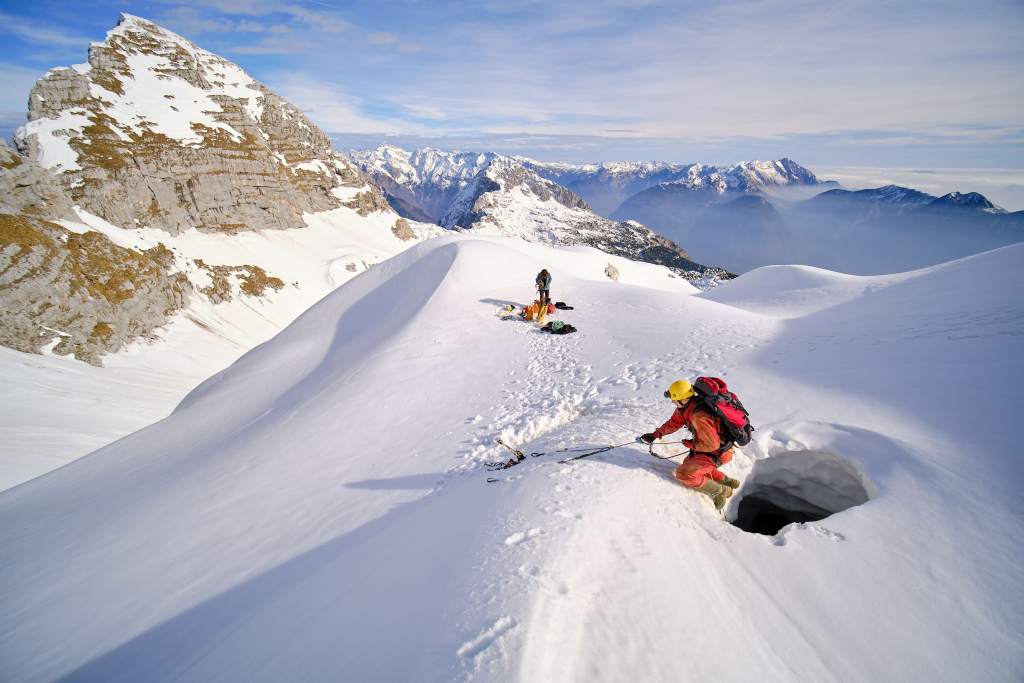
Entrance to Brezno Hudi Vršič, the highest entrance to Rombon Cave System, 2020;
the photo shows Ambrož Ileršič (right) and Mitja Mršek, with Velika Črnelska špica (2,332 m) in the background on the left; photo by Miha Staut
You mentioned at the beginning that you consider the Rombon Cave System your greatest achievement.
Can you tell us more about that?
I have been leading this project, together with Tone Palčič, since 2003.
It started within the Rakek Caving Club, but the people of Rakek didn’t quite comprehend
our vision, so we parted ways. The project moved with me to
Borovnica, closer to Tone’s club. At that time, I myself became a member of the Borovnica Caving Club
for a few years, the club Tone cofounded with like-minded people. However, the Borovnica club also
refused to accept the concept of high altitude cave exploration.
But the project must not and will not stop because of opponents.
If I look back a bit further, I could say that the project of Rombon Cave System
began taking shape in the minds of Tone and myself as early as 2001, with the aforementioned
expedition to the cave Čehi 2. During that expedition, the core group from Notranjska (Inner Carniola)
for exploring the deepest Slovenian caves took shape. We began rigging the Hudi Vršič
in August 2003, with Tone Palčič as the project’s conceptual leader, yours truly as the
execution leader, and the driving forces being also Tomaž Česnik (DZRJ Luka Čeč from Postojna),
Tomaž Mihevc (JK Logatec), Janez Puc (JD Rakek), Ivo Sedmak (a member of DZRLJ, later
a member of DZRJ Luka Čeč), and Rok Stopar (JD Dimnice from Koper). In seven expeditions
to the new cave branch we discovered on the opposite side in the upper part
of the enormous, at that time the deepest internal cave vertical in the world, the 385-meter-deep
shaft Zlatorog (Goldhorn Ibex), we reached a depth of 532 meters below the entrance. Only after
five years, in 2008, did we succeed, after several acrobatic attempts, to
find the continuation in the aforementioned hall. The years have flown by.
From the perspective of a deep cave explorer, I can safely say that they are now passing even more quickly.
In 2017, on our 34th expedition, we succeeded in surpassing a depth of one thousand meters.
On the next expedition, in 2018, our team — which also included Roberto Antonini,
Alberto dal Maso, Aleš Štrukelj, and Ana Makovec — managed to find a connection to the neighboring
deep cave, Črnelsko brezno.
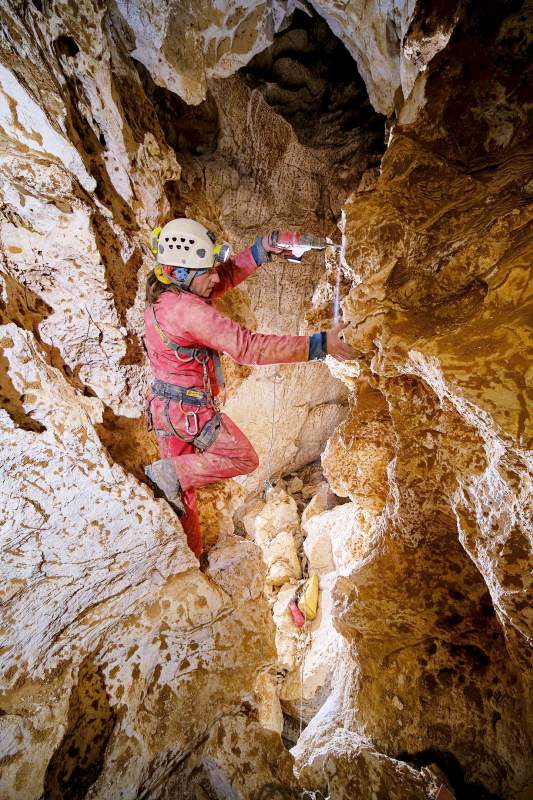
Mitja is rigging the Meander toward Kraljica (the Queen), February 2020; photo by Miha Staut.
Between 2019 and 2021, members of the Matica Club
(DZRJL) (Ljubljana matica)
— namely Matic Di Batista, Špela Borko, Jure Bevc, Vid Naglič, and Nika Pišek — also participated
in the exploration of the Gallery of the Old Rombonka River.
The Rombon Cave System, a network of connected caves was born,
in 2026 the deepest in Slovenia. It is
1,393 meters deep, and its length is steadily approaching 22 kilometers.
I stopped counting long ago from which club this caver is and from which
the other one, because I go caving with cavers who are usually much more
than just members of this or that club. Unfortunately, over the years,
some barriers have also arisen that my fellow cavers and I simply have to deal with.
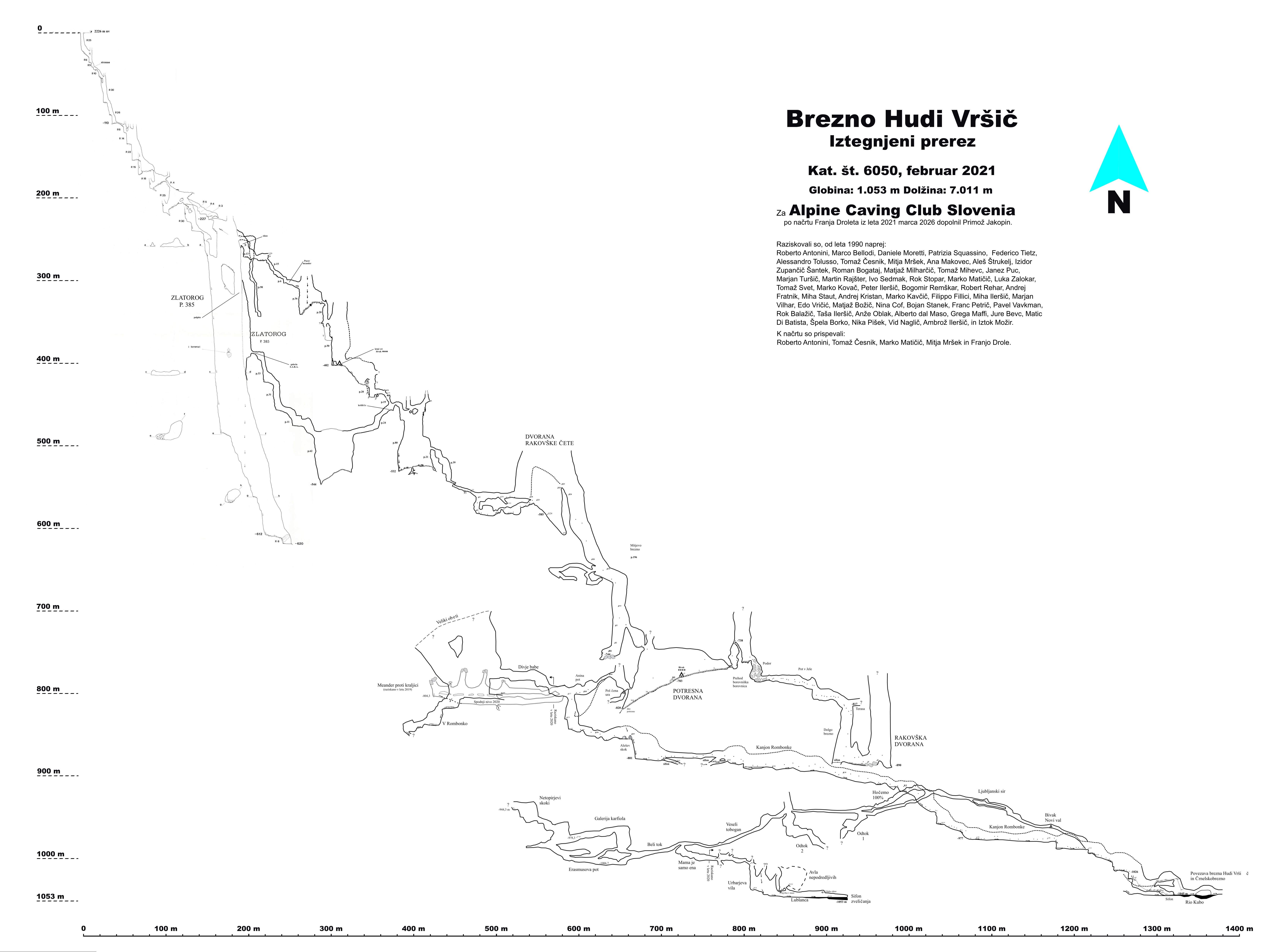
An extended cross-section of the Brezno Hudi Vršič Abyss, based on a map drawn in February 2021 by Franjo
Drole, in collaboration with Mitja Mršek; it is published here
with the consent of both.
At the far right below is the connection to the Črnelsko brezno, with which it forms the 1,393
meters deep and nearly 22 kilometers long Rombon Cave System, the second
deepest cave in Slovenia (as of 2026). The connection to Kraljica (The Queen), as
Mitja calls the cave Čehi 2 — shown in the center at the bottom of the map — the Meander
toward Kraljica, is still being explored. Click on the image, and again, to view it in full resolution.
The author has
added very little to the map, the data listed in the text box of the original map
corrected and supplemented, are also added to this description. The Italian
cavers were often written without first names, there were a few errors (Marko Kavčič was listed twice),
and now everybody is listed with his/her first name before the last name. They are most likely listed
in chronological order:
Roberto Antonini, Marco Bellodi, Daniele Moretti, Patrizia Squassino,
Federico Tietz, Alessandro Tolusso, Tomaž Česnik, Mitja Mršek, Ana Makovec, Aleš Štrukelj, Izidor Zupančič Šantek,
Roman Bogataj, Matjaž Milharčič, Tomaž Mihevc, Janez Puc, Marjan Turšič,
Martin Rajšter, Ivo Sedmak,
Rok Stopar, Marko Matičič, Luka Zalokar, Tomaž Svet, Marko Kovač,
Peter Ileršič, Bogomir Remškar,
Robert Rehar, Andrej Fratnik, Miha Staut, Andrej Kristan, Marko Kavčič,
Filippo Fillici, Miha Ileršič,
Marjan Vilhar, Edo Vričić, Matjaž Božič, Nina Cof, Bojan Stanek,
Franc Petrič, Pavel Vavkman, Rok Balažič,
Taša Ileršič, Anže Oblak, Alberto dal Maso, Grega Maffi, Jure Bevc,
Matic Di Batista, Špela Borko,
Nika Pišek, Vid Naglič, Ambrož Ileršič, and Iztok Možir.
Contributors to the cave map, starting in 1990: Roberto Antonini, Tomaž Česnik,
Marko Matičič, Mitja Mršek and Franjo Drole.
The Rombon Cave System is a world worth living for.
At least for me and Tone, this is undeniably true. Countless kilometers, countless
phone calls, countless questions, countless answers, countless
moments of love, countless disputes, and countless other things have accumulated over all
these years. We could also count the expeditions; if we limit ourselves to just the Hudi Vršič,
I probably won’t be wrong in saying that we (in 2026) are already at the number 50.


Rombonka River Canyon; the left image was taken by Mitja Mršek in 2022 at -1000 m, and the right one by Jure Bevc in 2019 at about the same depth (Wikimedia Commons).
In what ways do the caves on Rombon differ most from other deep caves you’ve visited?
In addition to these caves, I’ve also been to Kanin, to Mala Boka; I’ve made
the traverse from top (BC4 cave) to bottom twice; in Renetovo brezno and in P4, I helped with the
exploration, including at the expedition when we were still searching
for a connection between the two caves. I also participated in the exploration of Brezno spečega dinozavra
(Abyss of the Sleeping Dinosaur), at -1000 m. And — Diba and I climbed in P4, on the south side. At a glance
I’d say there’s quite a bit more floor area in Hudi Vršič, and often
you end up at the bottom of a large hall from a shaft, but the main difference is, of course,
the Rombonka River Canyon, which is much more picturesque, more colorful — at least to me — than
other river (aquifer) streams in high altitude Slovenian caves.
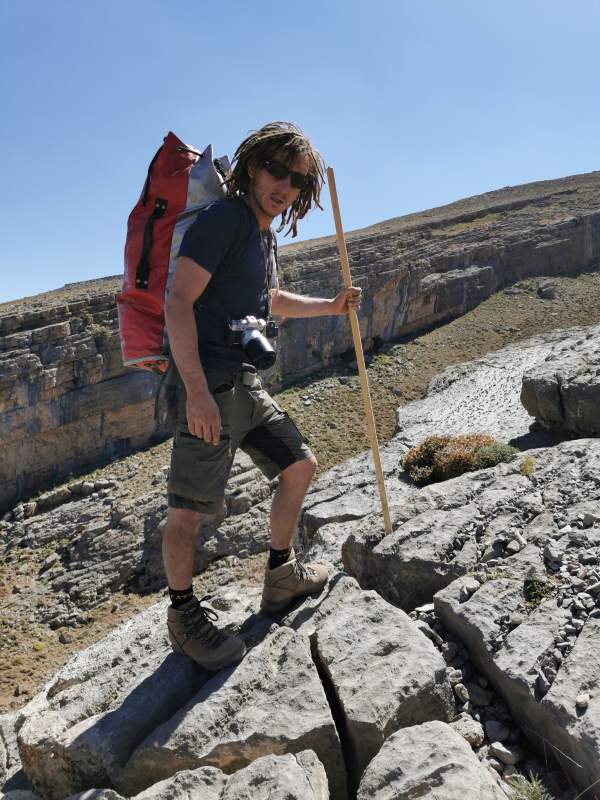
Mitja above Mitja's Cave at the edge of the canyon wall on Mt. Chul-Bair, 3200 meters above sea level, 2021, by the author
Speaking of caves, where else, besides Slovenia, have you explored them?
In 1998, we went to the American cave
Mammoth Cave, in 2003 back to
America, to the Hidden River Cave, in 2004 to Montenegro,
in 2005 to Ukraine, in 2006 and 2007 back to Montenegro, then
five times to Albania — in 2009, 2010, 2013, 2017, and 2018 — to the Spella e
Zeze (Black Cave), in 2013 (Mitja and Robert Grilc - Čevap) and 2018 (Mitja and Marjan Vilhar (1984-2020))
we also explored the Currajve River Canyon (the first descent into this canyon). In some places,
the canyon is several hundred meters deep.
In 2021, you and me went together to caves on Mount Chul-Bair in Uzbekistan.
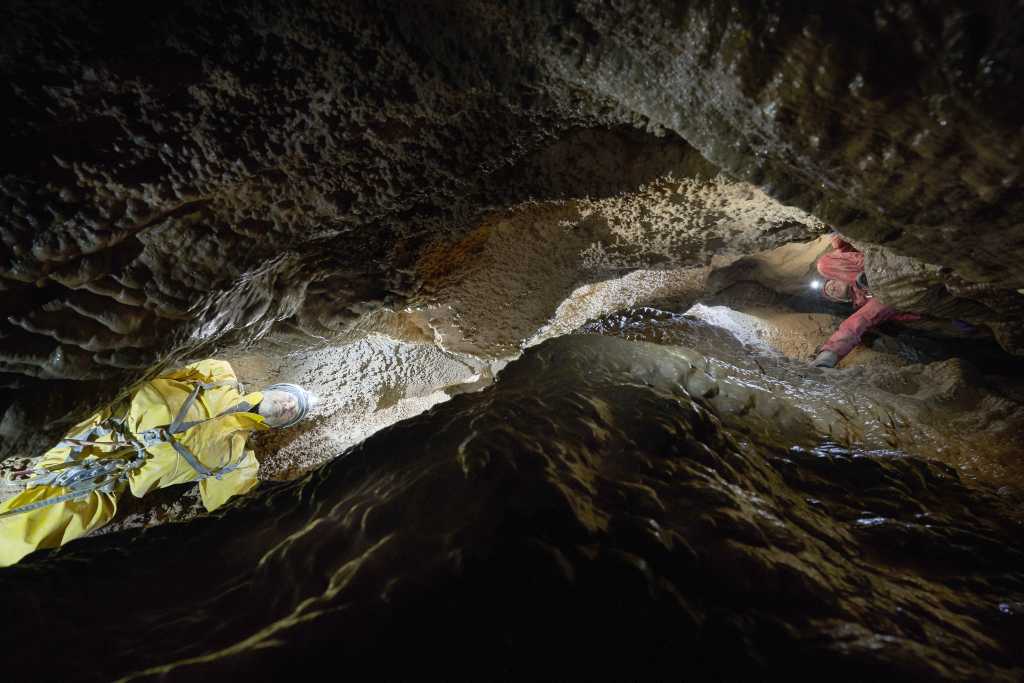
A meander in the upper part of the Višnjevski Cave, Artjom Šabaršin and Mitja; photo by Larisa Pozdnjakova, published with permission.
Where did you go in Montenegro, who else was there, and how did it go?
First, we explored the area around Njegoši, in 2005 and
2006, on a plateau about 1,000 meters above sea level, we searched for
cave entrances that would lead to springs by the sea (Sopot, Ljuta).
In the Belić area near the Albanian border, we also searched for a
thousand-meter deep cave in 2008, but it wasn’t exactly easy.
How was it in Albania? What stands out most in your memory from the expeditions and from Shpella e Zeze?
The Black Cave ascends gently from the entrance; at the time, it was the longest
cave in Albania; the climbing became increasingly risky, and the guys were getting more and more
hesitant because they knew that, just like in Uzbekistan, for instance,
you couldn’t count on cave rescue service should something go wrong.
In the cave Voronka above the camp at Čulbair, you dug a passage leading down. How did it go?
The cave is located exactly two-thirds of the way along the floor plan of the Višnjevski Cave,
from the entrance toward the end, and a passage through a 70-meter elevation difference would have
shortened the route to the bottom of Višnjevski from three days to one day. The digging, however,
was done in ice and snow, by hand. I came across a rock of about 50 kg that I had to move;
you helped me from the side, but we still couldn’t move it. We would have needed technical means or
a larger team. Unfortunately, there was no real understanding for the importance of this work.
What are your hopes and plans for this year, 2026, and beyond?
The plans have remained the same since the beginning of the exploration of Rombon: to organize
expeditions to Hudi Vršič and Čehi 2 that are compatible with the time participants can devote to it.
And perhaps to some nearby cave; the latest
example is Vrane (Crows) Cave, which could be another entrance to Čehi 2, located below Plešivec
(1,962 m, to the right of the Krnica Valley. We would get a new cave system even before connecting
Čehi 2 and Hudi Vršič.
Every year, a few expeditions come together, and this year will be no different. Otherwise, in my caving,
everything happens somewhat spontaneously. Sometimes I make an arrangement with one caver, at other times
with another.
An example is the latest expedition to Brezno Hudi Vršič from March 12 to 14,
2026. There was my humble self, Miha Staut and Maks Petrič. We set our goals a bit broader,
but then it boiled down to mostly photography, and it turned out quite well, as readers can see
from the following five photos.
Miha took all of them, and Maks and I helped out as best we could.
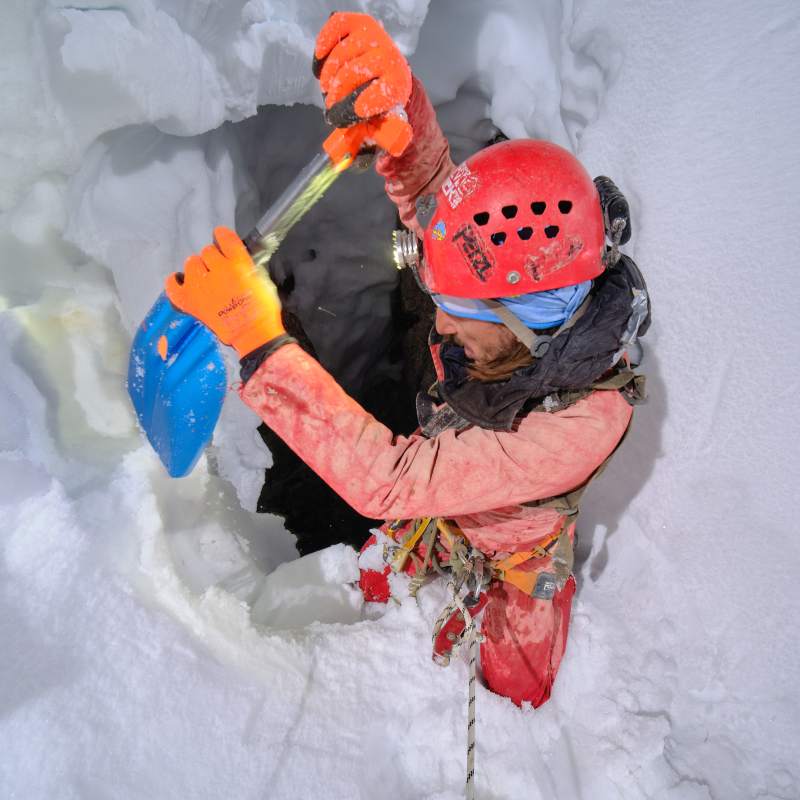
Mitja is clearing the entrance to the cave.
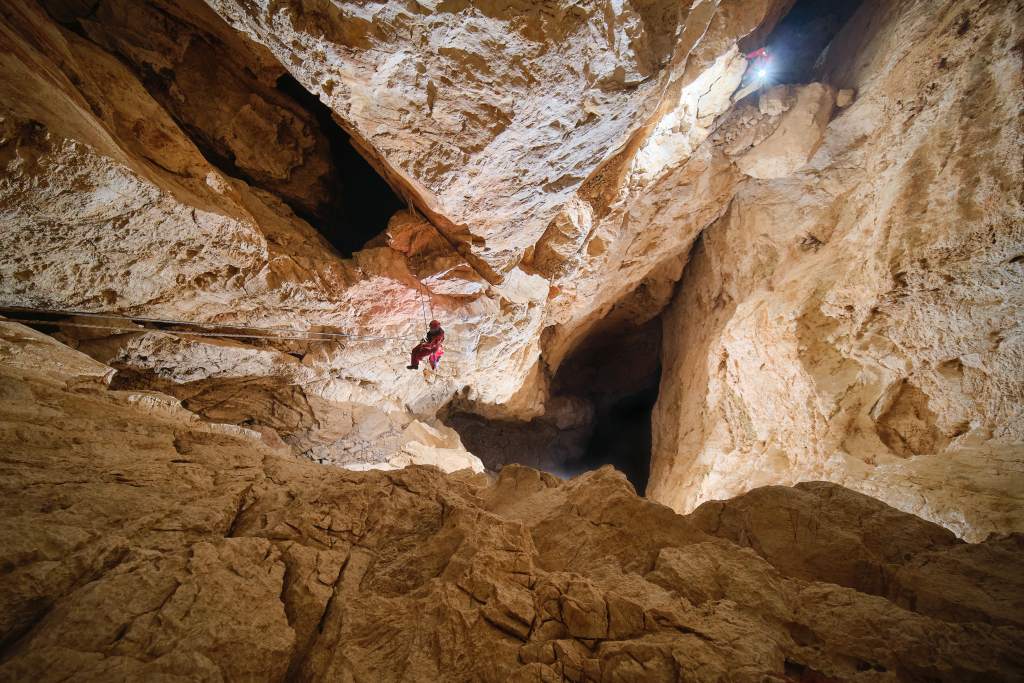 Mitja on a traverse in the 385-meter-deep Zlatorog abyss, Maks is at the top right.
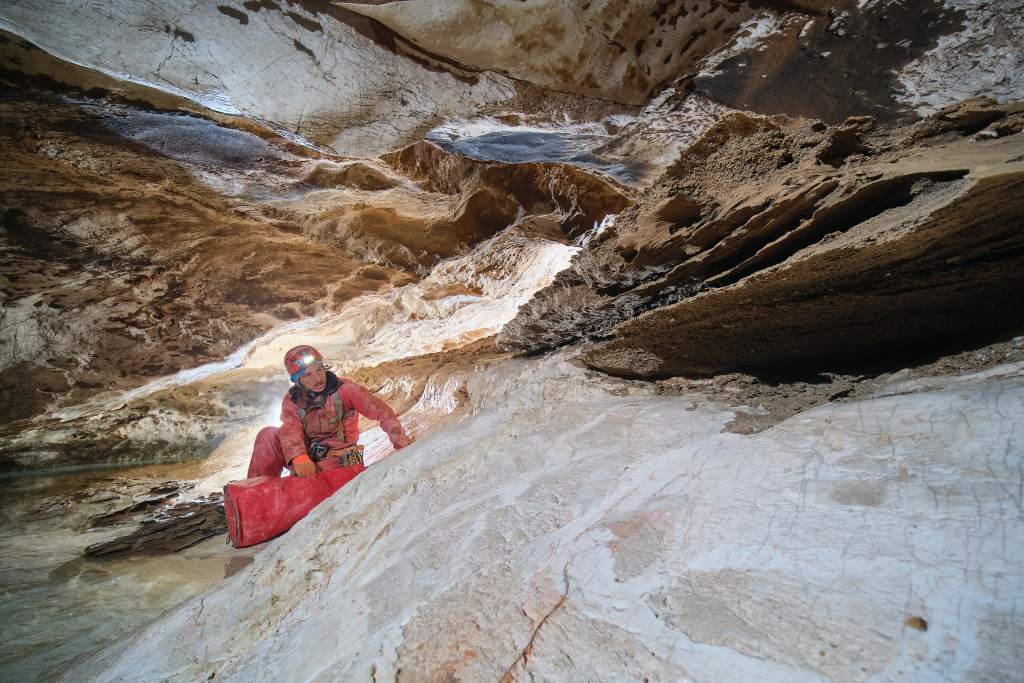
At the beginning of the Rombonka Canyon, at a depth of approximately 880 meters
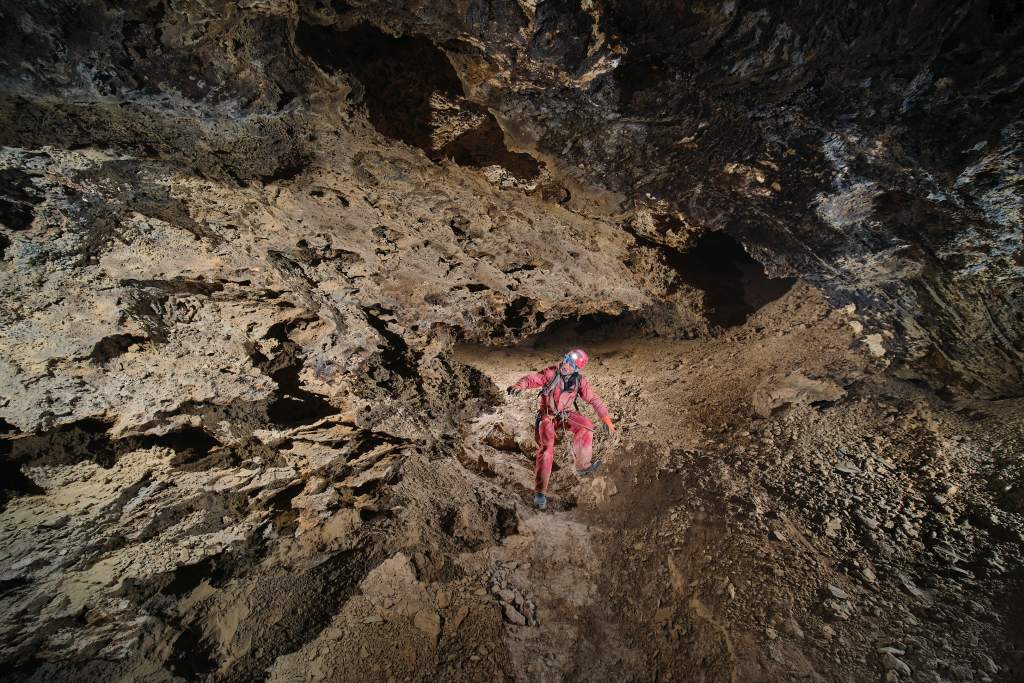
Descent into the initial section of the Stara Rombonka Gallery
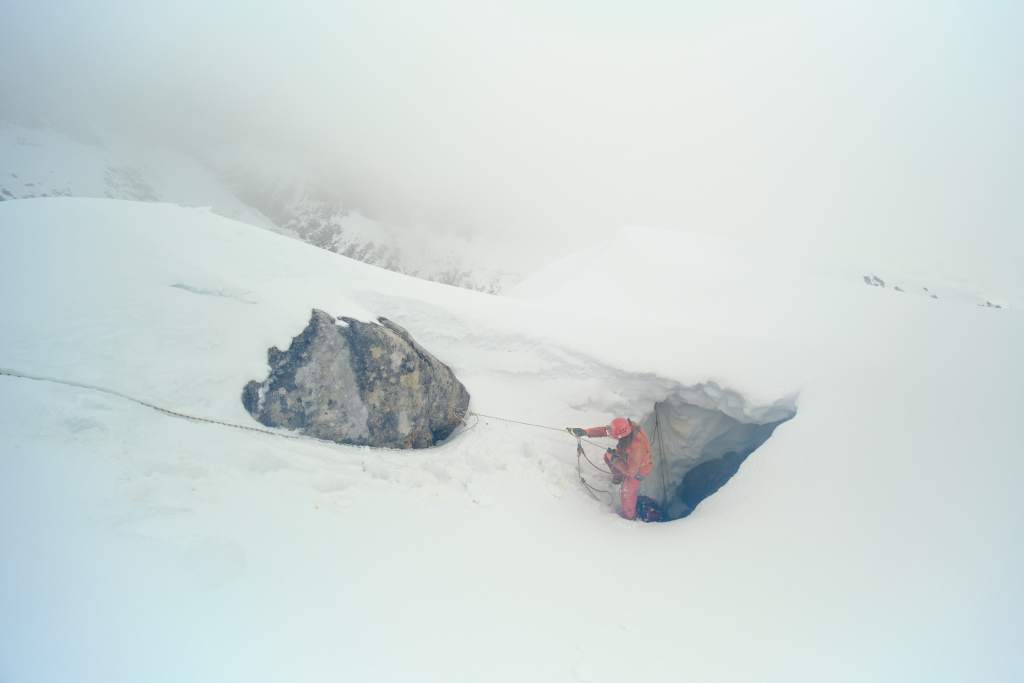
Mitja at the exit of the cave; it was noon, and there was fog.
The 2021 expedition to Uzbekistan happened out of the blue — you invited me at the Putik Award ceremony,
and the very next day I already had a plane ticket in my hands. Thanks again — Primož Jakopin Klok!!!
What can I say, there’ll probably be some good action with the Ljubljana crew, some with the Tolmin guys,
and we’ll get something going with the Styrians and the Littoral fellows —
the years go by ...
What do you think, will you guys get connected the Čehi 2 and Hudi Vršič with Črnelsko brezno first, or
will the DZRJL team (Ljubljana matica)
find a bypass of Matt’s siphon in Rene's cave first?
Ha ha... yeah, it would be best if the Matica guys reached Mala Boka as soon as possible,
otherwise the Poles will climb into Rene first! I don’t know, but I believe the Rombon Cave System is
also connected to Čehi 2; they’re not far one from the other.
And even if it doesn’t work out, I’ll still believe that we simply overlooked something. I say the same
for the Kanin system! It’s also certain that in both cases, it will take time. Since these are such
long-term goals I’d say the Ljubljana team will get there first! In the Rombon system, it’s the same —
it won’t work without the Matica cavers, and
that’s just how it is! Someone from your club will eventually get moving; I bet he will!
What’s the best and worst thing you’ve experienced in caves?
Good discoveries are always nice. The first such discovery was
Prešeren Hall in Logarček, around the year 2000 or a little earlier.
Tone (Palčič) was there, and Aleš (Štrukelj), and maybe also Ana (Makovec) and Janez (Puc). There
were several excursions. It was at the end of the Logatec Tunnel; the people from Logatec were always
looking for a continuation upward, they were climbing, while Palčič was lying under a chimney and
suddenly the wind blew out the flame on his carbide lamp. There was a small opening that we
expanded over several excursions. At the end of a narrow passage a few meters long, the cave
continued; there was a large chamber, 100 meters long, at least 20 meters
high, and quite wide. It was exactly February 8th (the day the greatest
Slovenian poet,
France Prešeren died), and we named it the Prešeren Hall.
It was even better in Hudi Vršič in November 2017. From
the Earthquake Hall at -800 m, where the bivouac is situated, we climbed just once
to the Sand Clock above the bottom of the hall. It truly deserves its name; the sand
pours into a small tunnel, and the whole area is quite buried. Above the Sand Clock, however,
there was something else visible, like a large darkness, worth seeing. I climbed up, Aleš
belayed me, while Ana stayed at the bivouac. At the top, the cave opened up; I went a little way
to look further ahead, then returned. Aleš and Ana returned to the surface the next day,
but Jokl (Andrej Kristan) arrived. We stayed for two more days and, on the very first day,
descended a few steps into the Rombonka Canyon (below -900 m) and followed it for about a kilometer.
It was the first time we had reached a water canyon in Hudi Vršič.
The feelings were indescribable, unlike anything we’d experienced before. In Hudi Vršič,
there were quite a few very pleasant surprises and top-notch adventures; in
recent years, the average has been 500 meters of new passages discovered per expedition.
This was also the case on December 18, 2021, in Primadona, part of the Migovec cave
system, at approx. -850 m, with Izi (Iztok Možir) and
Andrej (Fratnik), a Tolmin legend who had been there from the start at Mala
Boka and at Migovec, the first Yugoslavian to reach -1000 m in Črnelsko brezno, if I’m
not mistaken. At the end of the tunnel there was a shaft, and the Englishmen
(who were also exploring Migovec)
ran out of rope the last time they were there. We descended quite a distance,
where there was a junction (at -908 m); water flows in a waterfall into the next shaft, 20 m deeper,
and on the other side, a spacious gallery opened up, rising slightly.
We surveyed 501 meters of the passage; at the end, there was a collapse at the top, but we
didn’t check the side tunnels.
The scariest part, though, was when, near the bottom of the cave Čehi 2, at around
-1500 m, the water began to rise rapidly. On this expedition, which took place around
Christmas 2002, we reached the bottom of the cave for the first time. Also present were: Janez Marinšek,
Tomaž Česnik, Matjaž Milharčič, Janez Puc, Aleš Štrukelj, and Ana
Makovec, up to the bivouac at -1370 m. The bivouac was for four, so we split into two teams: the first
consisting of Česnik, Milharčič, and Štrukelj, and the second of Mršek, Puc, and Marinšek. The first
group went to the siphon at the bottom and returned to the bivouac, while the second group
also did the survey and reached the bottom after the first group had already left.
There was a ledge past the lake in the stream, and when I stepped onto a
rock on the ledge, the water was up to my ankles. Then we returned to the bivouac,
while the first group went down to the bottom again, without Štrukelj — he and Ana
had gone out because during the first visit to the bottom, Štrukelj’s grip had snapped and
he had fallen into the lake, which is now called Klamfina banja (Klamfa's bath).
They returned, having found nothing, the second group followed them; and when I stepped
on the same rock again at the ledge in the stream, the water was already up to my knees.
Much much more. I suggested we return immediately. At the bivouac, the members of the first
group had just fallen asleep, so we waited a little longer below the bivouac when
water suddenly began dripping from everywhere. At first it fell slowly,
drip, drip, drip, then faster and faster, tick, tick, tick, tick, tick. Then it
started to pour. In 15 seconds, it went from nothing to a downpour. We pulled the guys out of the
bivouac and rushed out. At -1,250 meters, there’s a steel cable across Terrano Lake.
Usually, at the lowest point, it’s half a meter above the water, but this time we
skidded across. At the lowest point, where the cable is anchored to the ceiling, there was only
20 cm of air left. It wasn’t until we crossed that point that I knew we were safe.

Alex, Pauline, Artjom, and Mitja in front of the entrance to the Boybuloq cave, 2021; photo by the author
You like proverbs, even the more lewd ones. Would you share some with us?
Why not:
There is no hero
that doesn't pee when he poops.
Every pussy
has an own source of profit.
A (punishing) twig grows for everyone,
the longer it grows, the thicker it will be.
Three slightly different questions to wrap things up. What would you pick as your favorite movie?
I don't know, I'm not really into movies. But if I had to
name something, let it be The Outsider.
And your favorite music?
Punk rock. Niet,
Pankrti,
Sex Pistols,
Rolling Stones.
For instance
Janez kranjski Janez, pa
Bandiera rossa ali pa
Behind the Iron Curtain.
What would be your favorite color, and why?
Blue, like the sky — that’s what everyone says, and I guess it’s true.
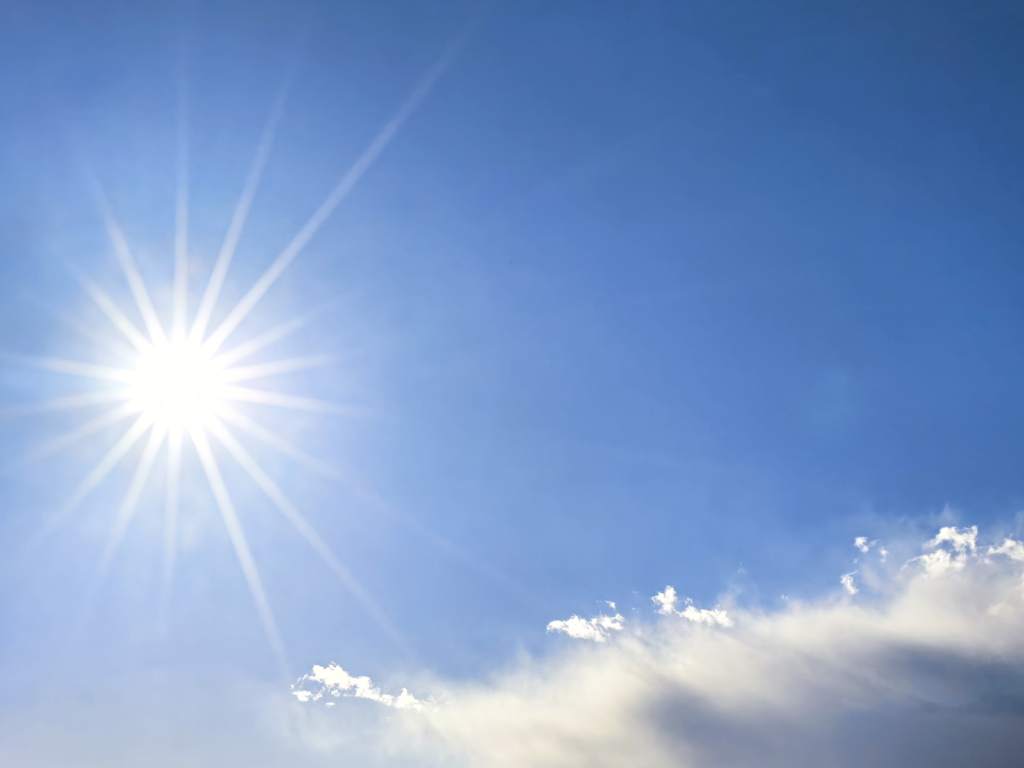
Sky over Zaplana with the sun and the
edge of a cloud, March 2026; photo by the author
Related posts:
 Hudojberdi Mustafokulovič Zokirov - son of Mustafo of Boybuloq, November 2023
 Yoav Litvin - from science to arts and politics, June 2026

This page, text and photos by Primož Jakopin.
Send inquiries and comments to primoz jakopin guest arnes si (insert dots and at sign as appropriate).
The page was initiated (in Slovenian) on December 7, 2021. It was completed in
March 2026 and translated into English by the author.
Last correction: June 15, 2026.
URL: http://www.jakopin.net/portraits/Mitja_Mrsek/MM_index.php
510